How Webflow Is Replacing Traditional Web Development for Growing Businesses

The way businesses build websites has changed and most companies have not caught up yet.
For years, the only serious option for a professional, scalable website was to hire a development team, write custom code, and commit to months of build time and ongoing technical maintenance. That model still exists. But a growing number of businesses are choosing a faster, smarter path and Webflow is at the centre of it.
Webflow is not a website builder in the traditional sense. It is a professional development platform that gives designers and developers full visual control without the bottlenecks of traditional code-heavy workflows. The result is a production-grade website built in a fraction of the time, at a fraction of the ongoing cost.
At Amilek, we have seen this shift happen across every industry we work in. Businesses that once waited six months for a website launch are now live in six weeks — without compromising on quality, performance, or flexibility.
Traditional web development works. But for most growing businesses, it carries costs and constraints that quietly slow everything down.
The core problem with traditional web development is not the technology. it is the architecture of how teams work within it.
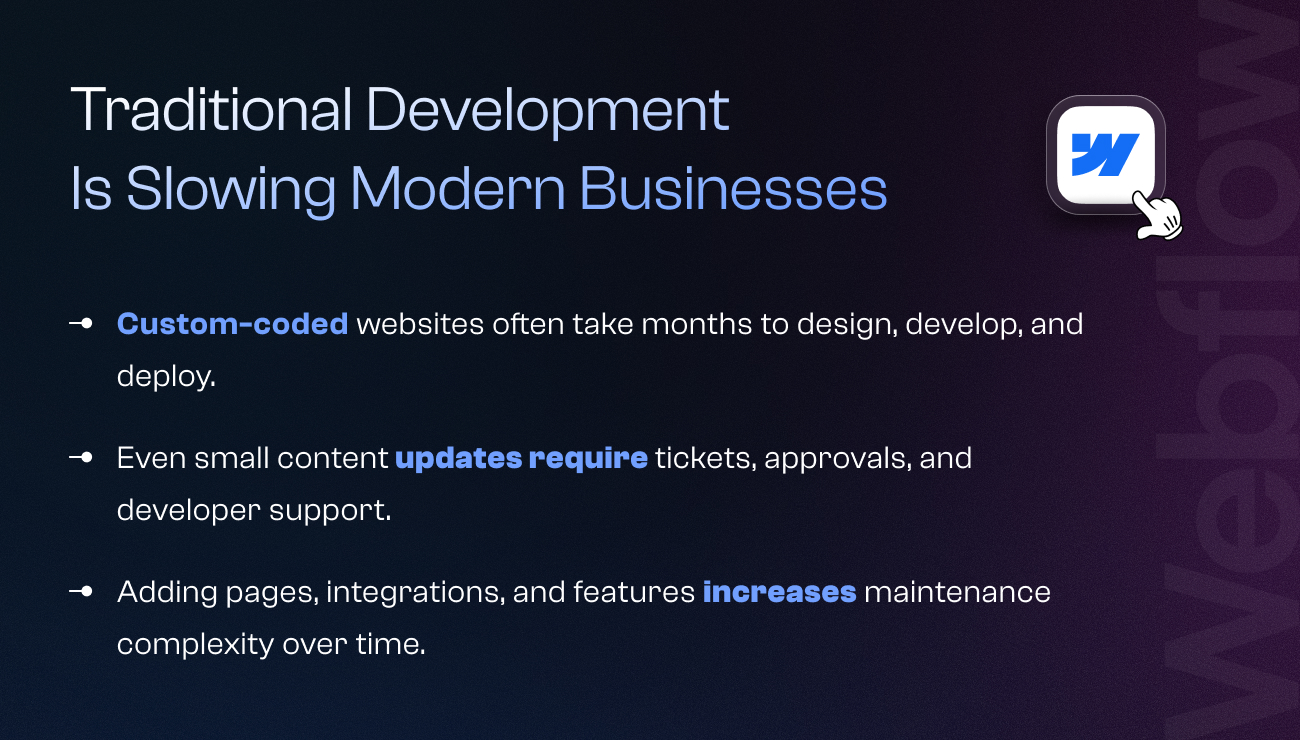
Design lives in one tool. Code lives in another. Content lives somewhere else entirely. Every update requires a handoff between people, tools, and timelines. That handoff is where projects slow down, costs increase, and the final product drifts away from the original vision.
Content teams are locked out of their own website. A simple text change requires raising a request, waiting for a developer to pick it up, reviewing the edit, and pushing it live a process that can take days for something that should take minutes.
Marketing teams cannot move at the speed of their campaigns. Landing pages, seasonal updates, and A/B tests that should be live within hours sit in development queues for weeks.
The architecture of traditional development was built for a world where websites were static assets, not living business tools. For growing businesses operating in fast-moving markets, that architecture is no longer fit for purpose.
Webflow resolves the core architectural problem by unifying design, development, and content management into a single platform without removing the ability to build complex, performant, production-ready websites.
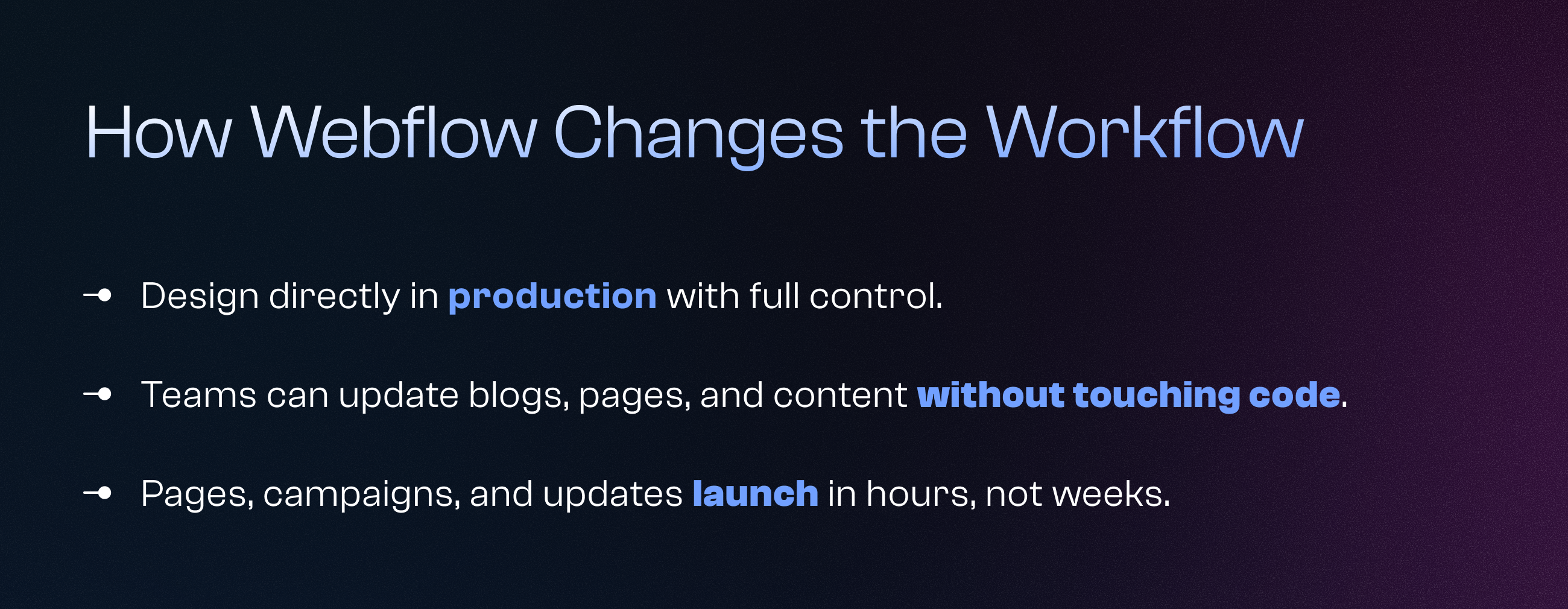
Designers work visually, in the same environment where the production site lives. What you design is what gets built. There is no translation layer between the Figma file and the live page, which means the final product looks exactly as intended.
Developers retain full control when they need it. Webflow generates clean, semantic HTML, CSS, and JavaScript meaning custom logic, API integrations, and advanced interactions can still be built directly within the platform or layered on top of it.
Content teams gain genuine independence. Once a site is built in Webflow, non-technical team members can update text, swap images, add blog posts, and publish new pages without touching a single line of code or raising a single ticket.
The result is a website that moves as fast as the business behind it launching faster, updating faster, and scaling faster than anything built the traditional way.
A Webflow website is not just fast to build it is built to perform visually in a way that directly influences how visitors perceive and trust your brand.
Design quality signals credibility. A visitor who lands on a visually polished, well-structured website forms a trust impression within the first three seconds. Webflow gives designers the precise control needed to craft that impression intentionally custom animations, fluid layouts, micro-interactions, and typographic systems that reflect a brand with confidence.
Colour consistency across every page, every screen size, and every device is built into the Webflow workflow from the start. Global style guides mean a change to your primary colour updates across the entire site instantly maintaining visual coherence without manual effort.
At Amilek, we use Webflow's design capabilities to build websites where every visual decision is intentional. Colour, spacing, motion, and hierarchy are all aligned to guide the visitor's attention toward the actions that matter most enquiry, trust, conversion.
Webflow is not just a design tool. Under the surface, it is a production-grade technology platform built for performance, security, and scale.
Sites built on Webflow are hosted on a global enterprise CDN meaning fast load times for visitors regardless of where they are located. Performance is built in, not bolted on.
SEO capabilities are native and accessible to non-technical teams. Meta titles, descriptions, Open Graph tags, canonical URLs, structured data, and sitemap generation are all manageable without developer involvement giving marketing teams direct control over search visibility.
Integration with the modern technology stack is seamless. Webflow connects natively with CRM platforms, analytics tools, email marketing systems, payment gateways, and custom APIs making it a genuine business platform, not just a front-end layer.
At Amilek, our Webflow development process covers every layer:
Final Thought: Your Website Should Work as Fast as Your Business Does
The question is no longer whether Webflow is a serious platform for professional websites. It is whether your business can afford to keep building the slow, expensive, maintenance-heavy way.
Growing businesses need websites that launch quickly, update without friction, and scale alongside the product and the team. Webflow delivers all three without the developer dependency that traditional builds create.
At Amilek, we specialise in Webflow development for businesses that are serious about their digital presence. From initial design system to full CMS build and third-party integration, we deliver websites that perform from day one and continue performing as your business grows.